
Toggle MRAM or STT-MRAM? Start With the Application
Toggle MRAM and spin-transfer torque MRAM (STT-MRAM) share the characteristics that draw designers to MRAM in the first place: data retention without power, fast access and the ability to rewrite data without the erase-before-write operations associated with flash memory.
They are still different design choices.
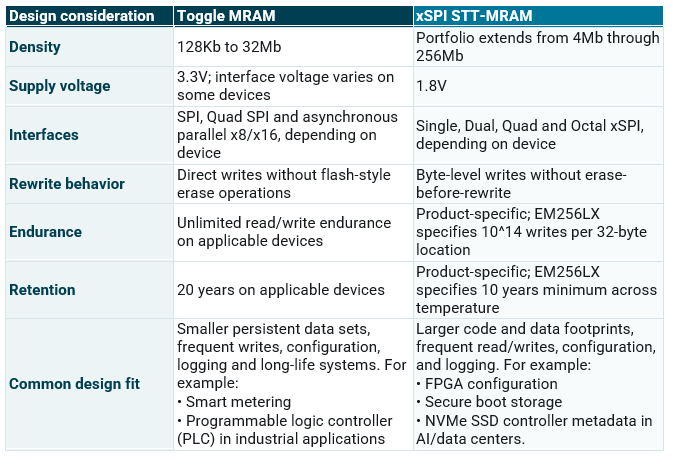
Everspin's Toggle portfolio serves 3.3V serial and parallel designs across densities from 128Kb to 32Mb. Everspin's xSPI (Expanded Serial Peripheral Interface) STT-MRAM operates at 1.8V and extends the MRAM portfolio into higher densities and faster serial interfaces. Depending on the system, interface, voltage or density may narrow the choices before other specifications even come into play.
That is also why STT-MRAM should not be viewed simply as the newer replacement for Toggle. Both remain useful because they solve different memory problems.
Where Toggle MRAM fits
Toggle MRAM has a long commercial production history and remains widely used in embedded systems that need persistent memory, frequent writes, endurance, long data retention and reliability and long product lifecycles.
Everspin's current Toggle portfolio spans 128Kb to 32Mb across serial and asynchronous parallel products. Interfaces include SPI, Quad SPI and x8/x16 parallel options, depending on the device. Toggle products operate from a 3.3V supply.
On applicable Toggle parts, Everspin specifies 20 years of data retention and unlimited read/write endurance. Once a write is complete, the data is already non-volatile; the device can write new data to the same location without first erasing a sector or block.
For systems that regularly update configuration settings, counters, logs or operating state, that changes how power loss has to be handled. The data remains in memory when power is removed without requiring a battery, capacitor or separate STORE operation. There is no need to detect a power failure and move the latest information from SRAM into non-volatile memory before the available energy runs out.
Those characteristics are one reason Toggle MRAM continues to be used in mission-critical applications across industrial controls, factory automation, metering, transportation, medical equipment and aerospace and defense systems. It fits especially well when the memory footprint is modest, writes happen frequently and the design needs an established interface over a long product life. Its non-volatility also helps preserve critical data through unexpected power loss.
Where STT-MRAM changes the equation
STT-MRAM moves into a different density, voltage and interface range.
Everspin's PERSYST EMxxLX family operates at 1.8V and supports Single, Dual, Quad and Octal SPI modes, depending on the device. The portfolio extends through 256Mb, and applicable Octal devices support operation up to 200 MHz with throughput up to 400 MB/s.
The devices support byte-level writes and can rewrite a location without an erase operation. That matters in applications where code, configuration or other persistent data may need to be updated frequently.
Endurance and retention vary by device. For example, the 128Mb EM128LX specifies 10^14 writes per 32-byte memory location and a minimum 10-year data retention period across temperature.
The higher densities and faster serial interfaces suit applications with larger code or data footprints than the current Toggle portfolio can address. STT-MRAM can support larger boot-code and data footprints, FPGA configuration, industrial computing and embedded systems that need higher serial bandwidth.
A recent design win shows how that can work in a real system. Astro Digital selected Everspin's 64Mb PERSYST STT-MRAM as the primary fail-safe memory for the boot process on an upcoming Raven bus geosynchronous Earth orbit satellite mission. The memory retains essential boot information without power and provides fast access during startup or recovery.
Everspin also offers a 1Gb ST-DDR4 STT-MRAM product for high-bandwidth persistent-memory applications. That device belongs to the same underlying STT-MRAM technology family, but it addresses a different architectural problem than and should be evaluated separately.
A practical comparison
Where the decision usually gets made
Interface and voltage can narrow the field quickly
A system built around a 3.3V asynchronous parallel bus starts from a very different point than one designed around a 1.8V Octal SPI interface.
That matters in a new design, but it can matter even more during a migration. A 3.3V host may need level translation to work with a 1.8V STT-MRAM device. Toggle and STT-MRAM should not be treated as board-level drop-in alternatives simply because both are non-volatile MRAM.
Density is only part of the workload
A few kilobits of calibration data and 128Mb of boot code clearly point to different devices. Write activity can be just as important in the applications that fall between those extremes.
A system that updates counters, event records or state information continuously puts different demands on memory than one that writes configuration data only occasionally. Toggle MRAM's unlimited endurance is particularly useful in high-cycle applications. STT-MRAM brings larger densities and higher serial bandwidth while still supporting frequent persistent writes.
Retention, temperature and qualification vary by part number
It is tempting to describe Toggle or STT-MRAM as if every device in each family carries the same environmental specifications. They do not.
Temperature range, data retention and qualification status vary by product. Match those requirements to the specific part under consideration, especially in automotive, aerospace, defense and other high-reliability systems.
The memory being replaced changes the conversation
NOR flash migrations often start with erase behavior, write performance, endurance and the amount of firmware work required to change the memory architecture.
Battery-backed SRAM presents another problem. The goal may be to keep data persistent through power loss without depending on a battery and its maintenance, size and end-of-life considerations.
nvSRAM is different again. Persistence is already part of the architecture, so migration can affect interface timing, STORE/RECALL behavior used to move data between volatile and non-volatile storage and how much existing hardware or firmware needs to change.
Those are different starting points and MRAM can address each of them. Both Toggle and STT-MRAM can serve as drop-in replacements, often requiring little or no hardware redesign. MRAM combines non-volatility with fast write performance and high endurance, making it well suited for applications with frequent updates, high system availability and long-term data retention. It can also provide designers with an additional qualified memory option to help reduce supply chain risk.
For more information, read this application note.
Why both remain in the portfolio
Everspin continues to develop and sell both Toggle and STT-MRAM because customers are solving different memory problems.
A 3.3V embedded system that needs a few megabits of persistent memory and expects very high write activity may point naturally toward Toggle MRAM. A 1.8V design that needs a larger memory footprint, xSPI connectivity and more serial bandwidth may point toward STT-MRAM. Plenty of applications fall somewhere between those examples.
The useful comparison starts with the actual system: how much memory it needs, how the host connects to it, how often the data changes, how long it must be retained and where the product has to operate.
If a design falls in the overlap between the two families, Everspin's application team can help compare the specific parts and requirements, rather than assuming one MRAM technology is the answer for every system.