
Everspin PERSYST™ MRAM: The New Standard for Aerospace, Satellites and Drones

Reviewers: Paolo Schiappacasse; Daniel Symalla; Mark McClain; Parthiv Pandya
MISSION CRITICAL PERSISTENCE
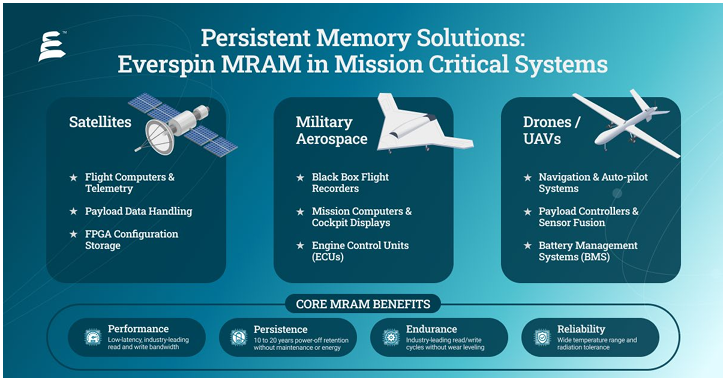
Why Persistent Memory Matters in Aerospace and Defense Systems
From Low Earth Orbit (LEO) satellites to high-performance tactical drones, aerospace systems demand memory technologies that can operate reliably in harsh and unpredictable environments. Mission‑critical applications — including flight control systems, avionics, telemetry, satellite payload processing, and guidance electronics — require deterministic performance, long data retention, and resilience to radiation‑induced faults. Everspin’s PERSYST™ STT-MRAM (Spin-Transfer Torque MRAM) provides the "Universal Memory" these applications require: combining the speed of SRAM with the non-volatility of Flash, but without the wear-out mechanisms or radiation vulnerabilities of either.
This value proposition is already being recognized in demanding space applications. As Billy Wahng, CTO of Astro Digital, noted: "Everspin’s MRAM has proven to be an optimal solution for demanding space exploration and LEO satellite missions. The addition of the HR version gives us the option to broaden the operating range of our systems."
PERSYST xSPI STT-MRAM for Aerospace and Defense
The PERSYST family is engineered for high-throughput, low-latency performance in embedded systems and IoT.
High Throughput: Support for Quad and Octal SPI (xSPI) interfaces with clock frequencies up to 200 MHz.
Massive Bandwidth: Achieves up to 400MB/s sustained read/write throughput, enabling rapid data logging and instant-on system operation.
Capacity Range: Scalable from 4Mb to 256Mb to fit everything from small sensor nodes to complex flight computers.
JEDEC xSPI Compliant: Replaces serial NOR Flash while delivering significantly higher performance.
Long data retention in powered or unpowered scenarios.
Deterministic write performance with no need for wear‑leveling
Benefits of MRAM for Aerospace, Defense and Space Applications
Radiation Immunity: Unlike Flash or SRAM which store data as electrical charge, MRAM stores data as magnetic states. This makes it inherently resistant to Single Event Upsets (SEU) and Latch-up (SEL) common in space.
Unlimited Endurance: Offers 1014+ write cycles, effectively unlimited for the life of any mission. For example, if a specific 32-byte region is ever worn, the system can simply write to a different 32-byte region for another 1014+ writes. In contrast, NOR Flash endurance is consumed on much larger 4KB to 256KB erase blocks, so a hot spot can wear out an entire block at once. MRAM’s fine write granularity makes wear-leveling unnecessary and removes any practical write-limit for mission life.
Wide Operating Range: Available in Industrial (-40°C to +85°C) Extended (-40°C to +105°C) and AEC-Q100 Grade 1 (-40°C to +125°C), ensuring stability during high temperature operation.
Low Power Consumption: Low active energy and deep power-down modes (<50 µA) reduce overall energy use in battery-powered and duty-cycled platforms. Because writes complete quickly and predictably, the system spends less time awake—cutting energy per update or data sample.
High-Speed Write Performance: Unlike traditional Flash memory, MRAM requires no erase cycle before writing. It operates at the full speed of the system bus, significantly reducing latency and energy compared to NOR Flash.
Data Integrity: MRAM commits data in small 32‑byte blocks, which helps prevent partial writes during sudden power loss and does not require external ECC.
Long Data Retention: Retention is driven by temperature/mission profile, not by program/erase wear, so it does not degrade with frequent updates. This avoids the endurance-versus-retention tradeoff seen in NOR Flash over long service life.
Use Cases: MRAM in Aerospace, Defense and Space Systems
Space and satellite systems: Radiation-tolerant storage for satellite flight computers, command and telemetry data, payload control, and communication subsystems.
Avionics and flight systems: Non-volatile memory for flight control, fly-by-wire architectures, navigation, flight safety, engine and propulsion control, and crash-survivable data recording.
FPGA and instant-on systems: Storage of configuration bitstreams for rapid boot, deterministic startup, and persistent mission-state retention.
High-speed mission data logging: Continuous logging for avionics, black box recorders, and other write-intensive systems without wear-out concerns.
Autonomous processing platforms: Real-time buffering for sensor fusion, image processing, and edge decision systems in tactical drones and eVTOL aircraft.
Power-aware embedded electronics: Low-power persistent memory for battery management and duty-cycled aerospace subsystems.
Technology Comparison: MRAM vs. FRAM, nvSRAM and NOR Flash for Aerospace Applications
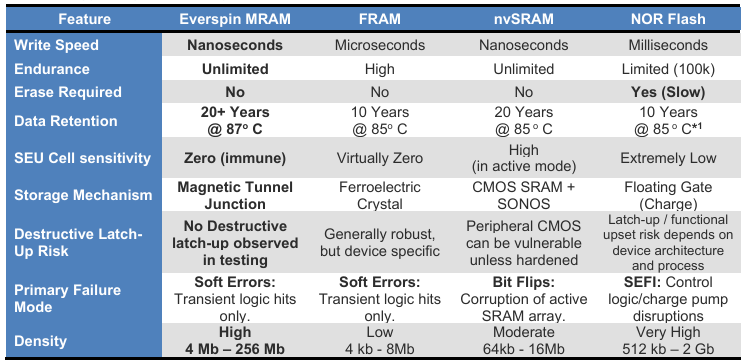
Why MRAM Is Well Suited for Mission-Critical Aerospace and Defense Systems
Everspin MRAM offers a compelling solution for aerospace and defense applications by combining non-volatile storage, high endurance, radiation tolerance, deterministic write behavior, and low power operation in a single memory technology. Compared with charge-based memories such as NOR Flash, MRAM removes erase before-write delays, wear-out concerns, and key reliability limitations that can compromise mission-critical systems. As avionics and autonomous platforms demand faster configuration updates, persistent mission logging, and robust retention of critical system states, MRAM provides a simpler and more resilient architecture for long-life, high-reliability designs.
REFERENCE DOCUMENTATION & REPORTS
MRAM for Radiation-hard Markets Everspin MRAM
NASA NEPP Radiation Effects Test Guideline for Nonvolatile Memories General NVM Guidelines
PEAL Radiation Test Report: EM064LX STT-MRAM SEE Characterization, Everspin Technologies (February 2026).
Key Finding: Confirmed SEL immunity up to 61 MeV * cm2/mg at ambient temperature and high resilience to Total Ionizing Dose (TID) up to 1 Mrad (Si).
NASA/TM-20250005202: Single-Event Effects Test Report Micron MT25QU512ABB Serial NOR Flash Memory, NASA Goddard Space Flight Center (May 2025).
Key Finding: Demonstrates "hard" failure modes and significant SEFI (Single Event Functional Interrupt) risks starting at much lower energy levels (LET < 10 MeV * cm2/mg) and parametric degradation after ~30 krad (Si).
For more information on PERSYST MRAM and high-reliability solutions, please contact our sales office in your region: Worldwide Sales Offices