
When Failure Isn’t an Option: High-Reliability Memory for Mission-Critical Systems
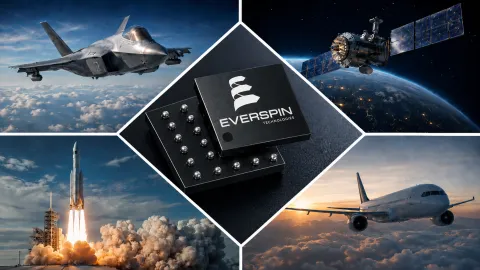
Why aerospace, defense, automotive and industrial designers are turning to MRAM for persistent, high-speed memory under demanding operating conditions
A memory failure in a consumer device may be an inconvenience. In a satellite, defense platform, autonomous vehicle or industrial control system, the same failure can interrupt a mission, corrupt critical data or prevent a system from recovering as designed.
High-reliability (Hi-Rel) components are designed, manufactured and tested for applications with demanding operating conditions and long service-life requirements. They are the foundation of mission-critical applications in aerospace, military defense, automotive and industrial systems, environments where failure can result in catastrophic consequences, significant financial impact or loss of life. That level of reliability depends in part on how data is handled within these systems. Memory is central to that equation because configuration data, operating state, telemetry and event logs may need to survive a sudden loss of power or system reset.
Magnetoresistive RAM (MRAM) addresses these requirements by bringing together capabilities that are difficult to achieve in a single memory technology: non-volatility, high endurance, fast writes and reliable operation across demanding environments.
What Is Electronics Reliability?
Electronics reliability is the ability of a device or system to perform its intended function over a defined period and under specified operating conditions. For memory, that means more than retaining bits. It includes maintaining data integrity, meeting access-time requirements, supporting the expected write workload and behaving predictably across the application’s temperature and operating range.
Durability describes a component’s ability to maintain specified performance while exposed to environmental and operational stress. Depending on the application, that may include temperature cycling, humidity, mechanical shock, vibration and radiation.
Hi-Rel components are designed to survive conditions that would cause standard parts to fail. Therefore, component selection must consider both the rated operating range and the qualification or characterization data relevant to the intended environment. Screening, process control and lot traceability help establish that devices continue to meet their specifications over the required service life.
Beyond durability, Hi-Rel memory must deliver consistent, repeatable performance throughout the application’s service life. MRAM supports that requirement by preserving critical data through power interruptions while providing the endurance and fast write performance needed for frequent updates.
Metrics and Standards for Electronics Reliability
Hi-Rel components must achieve exceptionally low failure rates. Mean time between failures (MTBF) estimates the average time between failures during normal operation of a repairable system. A higher MTBF indicates greater reliability; for example, a satellite subsystem rated at 100,000 hours provides far greater confidence than one rated at 10,000 hours. Mean time to failure (MTTF) measures the average time before the first failure of a non-repairable device, especially relevant in locations where repair is impossible, such as deep space missions or implanted medical devices.
These metrics are collected using accelerated aging tests, which simulate years of operation by exposing components to elevated stress. Consistency is verified through lot-level testing, traceability protocols and strict quality-management systems, often governed by standards specific to different types of electronics and industries.
Beyond these performance metrics, established industry standards set application-specific requirements for Hi-Rel electronics, defining the testing, screening and qualification protocols components must pass:
- Military standards (MIL SPEC / MIL STD), set by the U.S. Department of Defense, define performance, testing and qualification for electronic components—such as MIL-STD-883 for environmental testing—to ensure reliability across defense systems.
- Aerospace standards like NASA’s EEE-INST-002 and Europe’s ECSS-Q-ST-60 outline selection, screening and qualification of electrical, electronic and electromechanical (EEE) parts for space missions, ensuring reliable procurement and assurance for U.S. and European programs.
- Automotive standards include AEC-Q100 for stress testing integrated circuits under harsh conditions and ISO 26262, a framework for functional safety throughout the life cycle of automotive electronic systems.
- Semiconductor standards and specifications include the IEC 60747 series for semiconductor-device requirements and test methods, while military specifications such as MIL-PRF-19500 establish performance requirements for discrete semiconductor devices used in high-reliability applications.
Growing Demand for Persistent Memory in Hi-Rel Systems
As mission-critical systems evolve in complexity and capability, so does the volume of data they must process, store and protect. This is driving demand for larger, faster and lower-power persistent memory solutions that can keep pace with the expanding requirements of aerospace, defense, automotive and industrial applications.
Modern Hi-Rel systems generate and retrieve information from large data pools to inform complex decisions and actions, so this information must be retained and protected even in the event of a power loss or system reset. From flight telemetry and navigation data to real-time sensor fusion in autonomous vehicles, the need for non-volatile memory that delivers the speed of SRAM with the persistence of flash has never been more critical.
In recent years, MRAM has been increasingly recognized as an ideal solution for Hi-Rel applications. Unlike traditional memory technologies, MRAM combines non-volatility with high endurance and fast write performance, allowing systems to retain critical data without relying on external batteries or backup power systems. It also does not experience the same wear-out mechanisms as flash memory, making it well-suited for applications that require frequent data writes over long life cycles. MRAM’s inherent radiation tolerance further supports its use in aerospace and defense systems, where maintaining data integrity under ionizing radiation exposure is essential.
MRAM for Mission-Critical Electronics
For more than a decade, Everspin Technologies has supported MRAM deployments across field-programmable gate array (FPGA) and space-grade component ecosystems, including high-reliability applications in aerospace and defense, working with providers such as QuickLogic, Honeywell, Astro Digital and Frontgrade. The recent expansion of the high-reliability PERSYST™ MRAM family to 256Mb densities reflects Everspin’s commitment to meeting growing demand for scalable, persistent memory solutions that combine speed, endurance and non-volatility for mission-critical systems.
Delivering higher densities is only part of the equation. Everspin also prioritizes device reliability under extreme conditions. For instance, PERSYST MRAM underwent single-event effects (SEE) testing, a key step in qualifying any memory device destined for radiation environments. This third-party evaluation was conducted at the Jet Propulsion Laboratory (JPL) under ASTM F1192 and JESD57 standards, including SEL, SEGR and SEB characterization across a wide temperature range. The test was essential for verifying the MRAM’s stable magnetic-state behavior under radiation, with no retention drift, no wear-out effects and no unexpected responses as radiation and temperature increased—conditions that often require additional mitigation for charge-based memories.
For engineers building aerospace, defense and high-reliability industrial systems, consistent non-volatile performance is often as important as raw speed. Backed by over a decade of proven Hi-Rel deployments, more than 700 patents and a deep commitment to innovation, Everspin continues to advance MRAM technology for the systems where failure is not an option.
Building Reliability from the Ground Up
Hi-Rel components represent the gold standard in electronic quality and performance, and this standard continues to rise. As mission-critical systems grow more complex, achieving true reliability requires a layered approach: understanding the core principles of durability, consistency and fault tolerance; validating performance through rigorous metrics and life cycle testing; and meeting the industry standards that govern aerospace, defense, automotive and industrial applications. Equally important is choosing the right memory technology, especially one that delivers persistent, high-speed data retention.
If you're interested in learning more about our Hi-Rel products click here.